Discussion
Loading...

Post

  • About
  • Code of conduct
  • Privacy
  • About Bonfire
Corey S Powell
@coreyspowell@mastodon.social  ·  activity timestamp 3 days ago

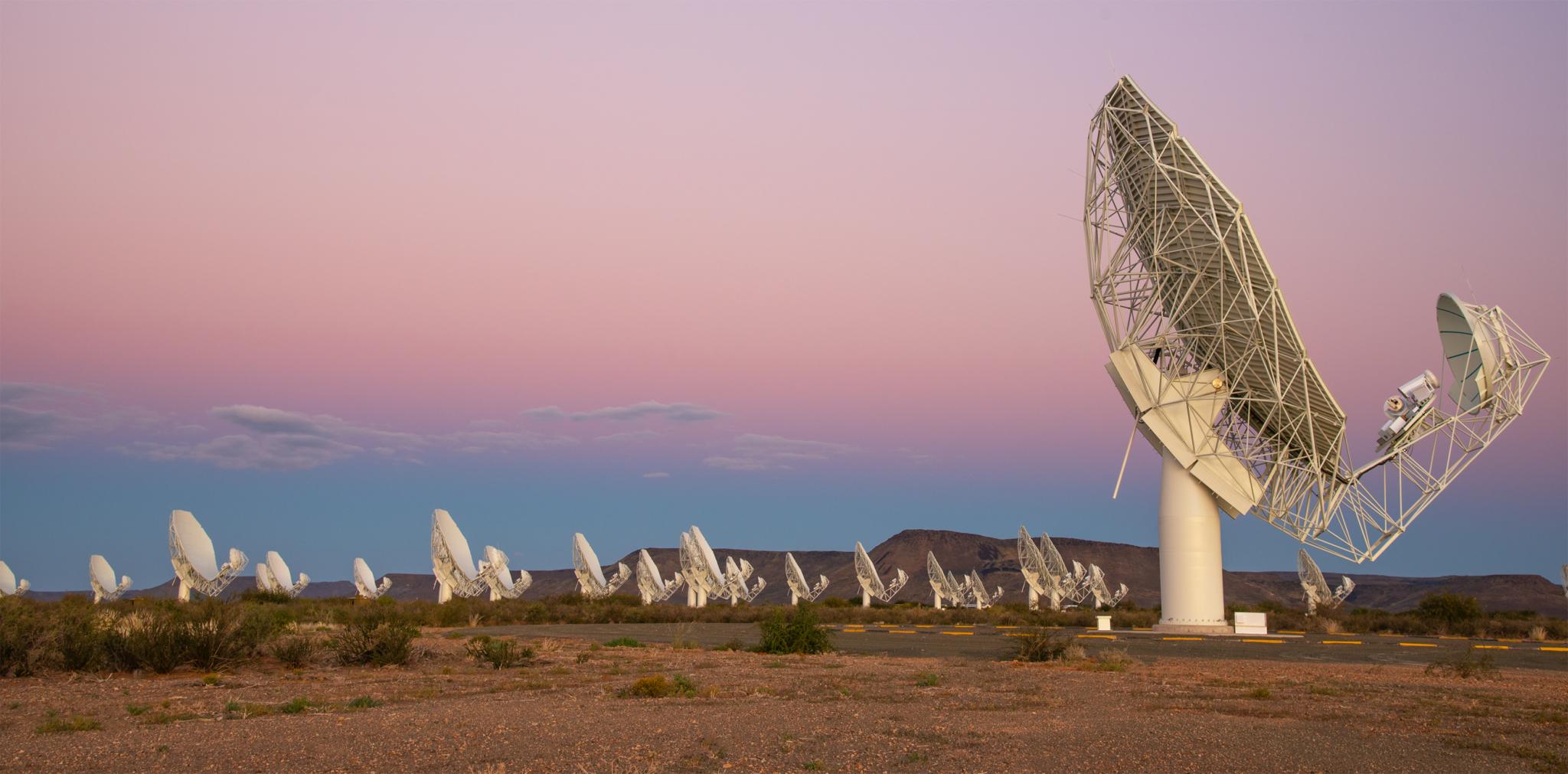
A major advance is using the MeerKAT radio telescope to map emission from hydrogen clouds in otherwise-invisible galaxies.

By combining different types of vision, astronomers are now bringing hidden parts of the universe into view.

Full paper at link.

https://arxiv.org/abs/2603.09339 #astronomy #space #nature #tech

arXiv.org

Hidden Vela Supercluster Revealed by First Hybrid Redshift & Peculiar Velocity Reconstruction

A large fraction of the extragalactic sky is obscured by foreground dust and stars along the plane of the Milky Way, leaving a major gap (~ 20%) in whole-sky maps of large-scale structures -- an incompleteness that is even more severe for peculiar velocity samples. This has long limited an unambiguous interpretation of observed cosmic flows and their connection to the underlying mass-density field. We present a new hybrid reconstruction methodology which combines 65,518 galaxy peculiar velocity distances from the CF4++ catalogue (Courtois2025) with 8283 new galaxy redshifts observed near the southern Galactic plane (|b| <= 10 degrees) Zone of Avoidance. A major advance is the inclusion of 2176 high-sensitivity, interferometric HI redshifts obtained with the SARAO MeerKAT telescope which for the first time provide coverage of the innermost 3degrees-wide strip of the southern ZOA and to unprecedented depth. This hybrid redshifts & peculiar velocities approach yields a substantially revised view of the inferred overdensities in and around the ZOA. In particular, the Vela supercluster emerges as a dominant mass concentration, rivaling the Shapley concentration and exceeding the mass associated with Laniakea and the Great Attractor region. With a total mass of 33.8 10^16 Msol, a characteristic radius of 70 hmpc, and a double core morphology at a distance of 189 hmpc, Vela dominates the mass budget and gravitational influence of the southern Zone of Avoidance. These results provide the most complete and dynamically consistent picture to date of the southern Zone of Avoidance and demonstrate the transformative potential of hybrid reconstruction techniques tailored for the next generation of large-scale surveys.
The MeerKAT telescope in the Karoo. Since its inauguration in 2018, the 64 dish array has been used to investigate a variety of questions in modern astrophysics such as how galaxies form and evolve across cosmic history.
  • Copy link
  • Flag this post
  • Block
Log in

Hiti

हिति , in Nepāl Bhāṣā, is the word for a shared community water tap. Even in modern Newar cities, these ancient structures still pour out fresh mountain water piped through ancient underground filters and conduits. They are a place to wash, to talk, to drink, to meet the locals: a nourishing, refreshing social-ecological place.

Hiti: About · Code of conduct · Privacy ·
Bonfire social · 1.0.0 no JS en-GB
Automatic federation enabled
  • Explore
  • About
  • Code of Conduct
Home
Login